2025 Yoshinori Ohsumi Award for Fundamental Research Awarded to Three Researchers
Three researchers have received the 2025 Yoshinori Ohsumi Award for Fundamental Research, which provides financial support from Institute of Science Tokyo (Science Tokyo) to researchers under the age of 40 engaged in fundamental research. The award ceremony was held on February 5.
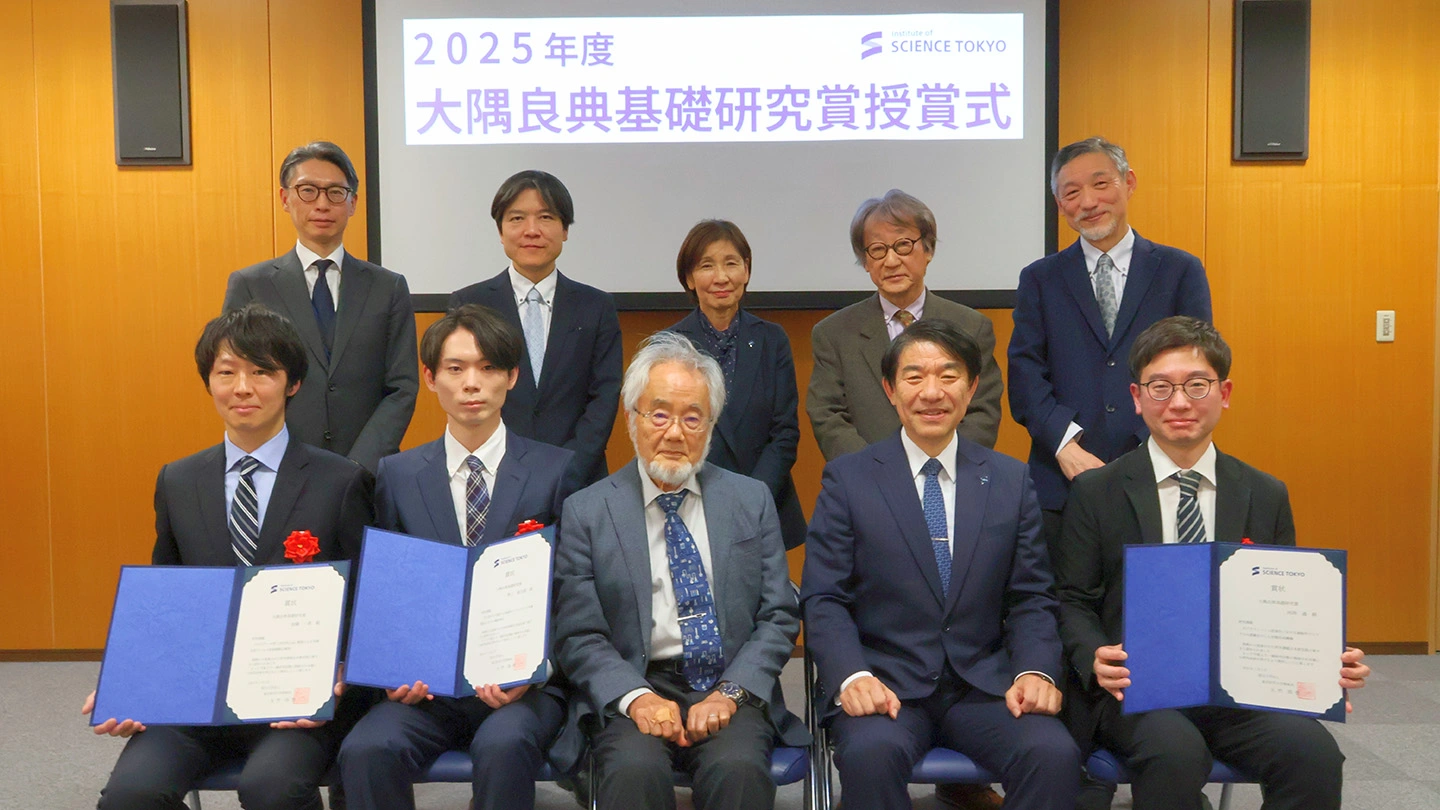
The Yoshinori Ohsumi Award for Fundamental Research was established in fiscal year 2018 using funds from the Yoshinori Ohsumi Memorial Fund, which was created by Science Tokyo (former Tokyo Institute of Technology) based on a donation from Honorary Professor Yoshinori Ohsumi, the 2016 laureate of the Nobel Prize in Physiology or Medicine. The program provides research grants to support early-career researchers in fields of basic research requiring a long-term perspective. For the eighth cycle in fiscal year 2025, 36 applications were received and three were selected.
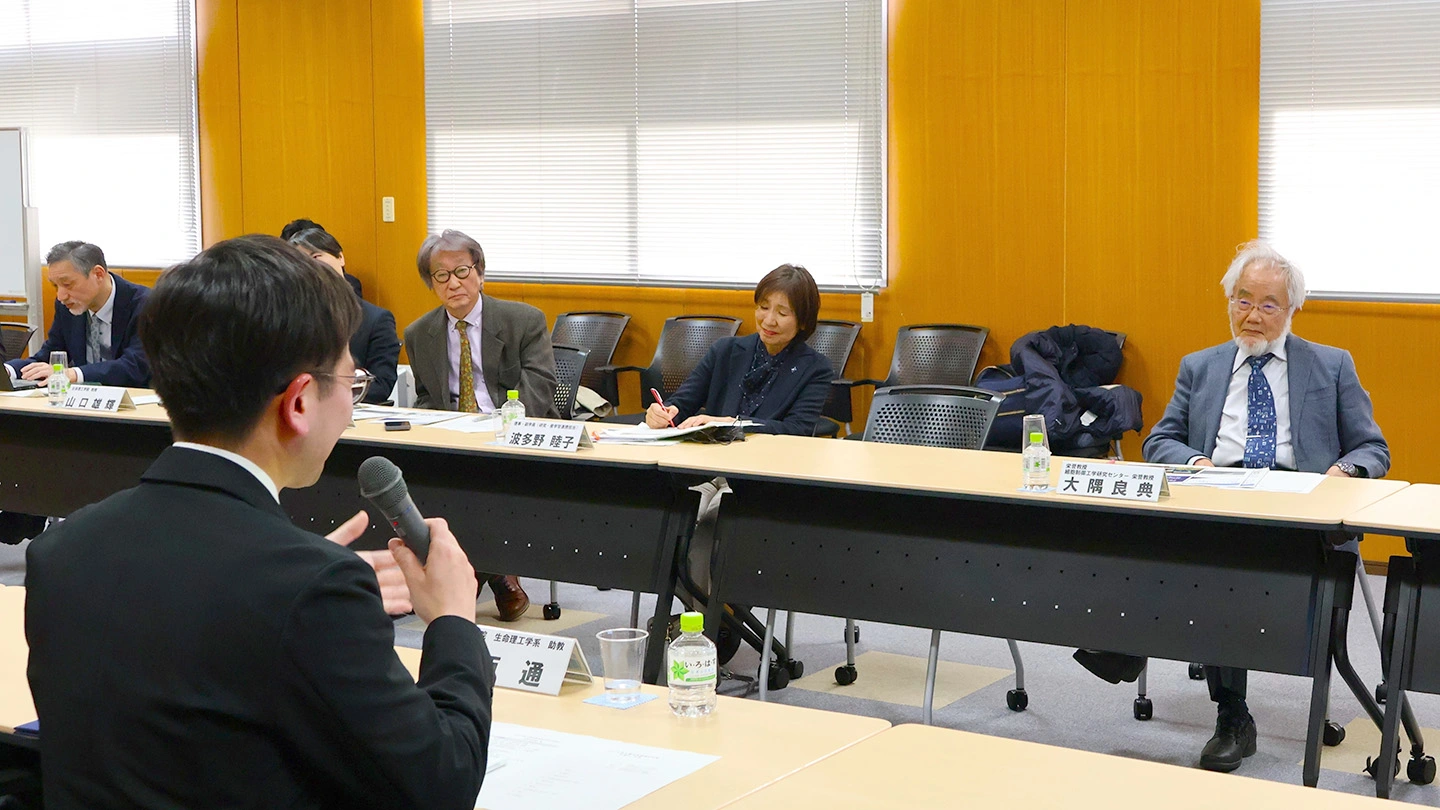
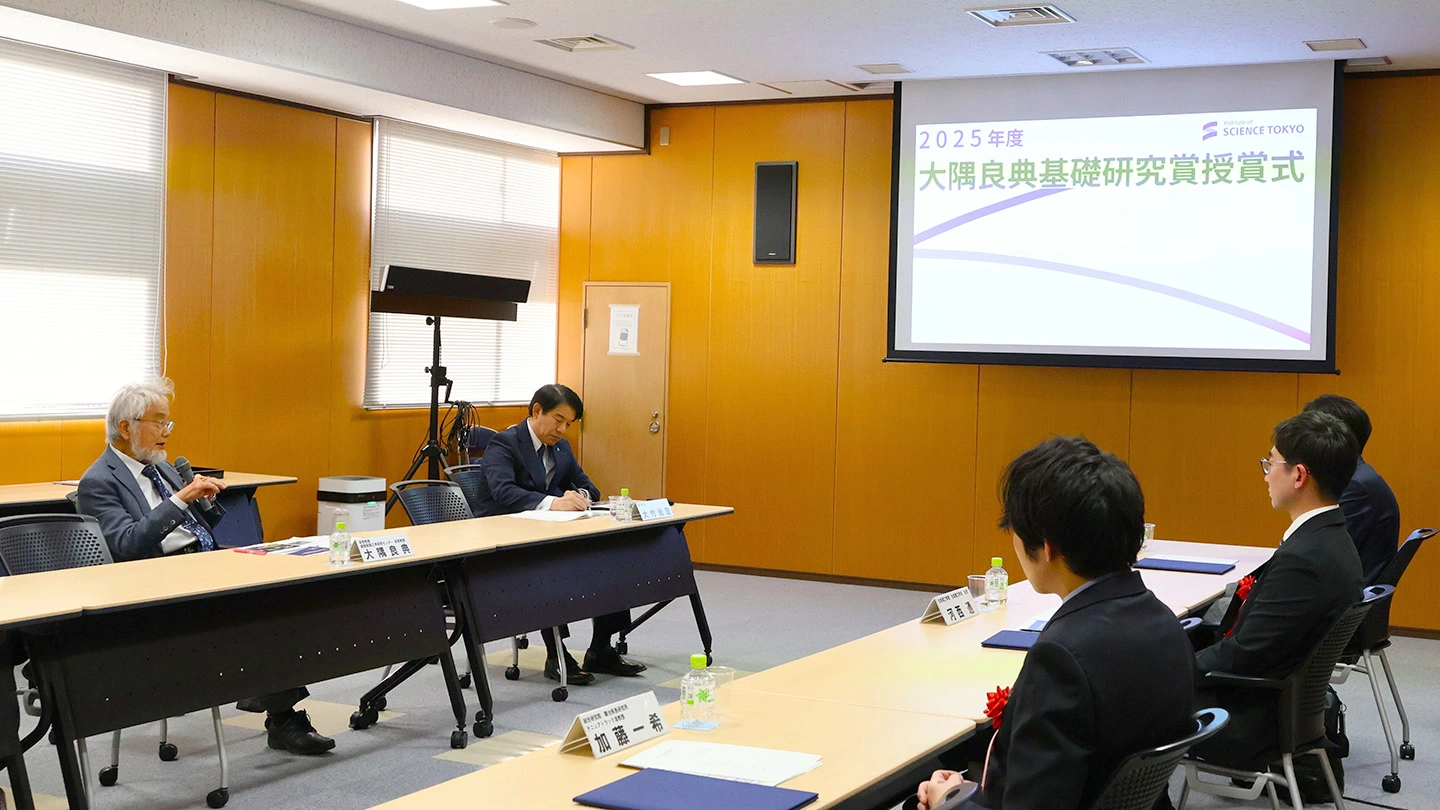
During the ceremony, President and Chief Executive Officer Naoto Ohtake explained Science Tokyo’s support initiatives for fundamental research to the award winners, and Honorary Professor and 2016 Nobel laureate in Physiology or Medicine Yoshinori Ohsumi delivered a congratulatory speech. The award winners, Ohtake, screening panel members including Executive Vice President for Research and Industry-Academia-Government Collaboration Mutsuko Hatano, and Honorary Professor Yoshinori Ohsumi later enjoyed conversation during which they actively exchanged opinions regarding topics such as current research themes of the award winners.
FY2025 Award Winners
Assistant Professor Juntaro Nogami
Department of Chemical Science and Engineering, School of Materials and Chemical Technology
Research Topic:Development of Asymmetric Nanocarbon Synthesis Overcoming Molecular Strain and Chiral Function Exploration
In organic molecules, a property known as π-conjugation, in which electrons are delocalized throughout the molecule, is crucial for enabling various functions such as luminescence, conductivity, and biological activity. This feature is used in many fields, including organic LEDs, organic semiconductors, and pharmaceuticals. A typical example is nanocarbon molecules composed of fused benzene rings. Recently, researchers have discovered that bending or twisting these normally flat nanocarbon molecules can significantly alter their properties and even generate entirely new functions. However, distorting the rigid π-conjugated molecules naturally involves an energetic penalty, making it challenging to synthesize complex three-dimensional structures using conventional methods. In this research, we aim to develop a new synthetic strategy that precisely controls molecular deformation by introducing bridging units within the π-skeleton. This approach will enable the synthesis of three-dimensional nanocarbons with curved and twisted structures. By elucidating the unique properties, such as molecular chirality and dynamic motion, arising from their topological structures, this work aims to make fundamental contributions to the field of organic materials chemistry.
Assistant Professor Toru Kawanishi
Department of Life Science and Technology, School of Life Science and Technology
Research Topic:Morphogenetic mechanism via transportation of dynamic extracellular matrix during zebrafish embryogenesis
Our body not only consists of cells, but also relies on a mesh-like network of large molecules outside cells called the extracellular matrix (ECM). The ECM supports tissue formation by providing a scaffold for cell migration and by transmitting signals that regulate cell proliferation and differentiation. Although the ECM has long been considered a spatially fixed structure, dynamic ECM movements during embryonic development have recently been reported. However, the roles of these movements remain unclear. Here, I focus on a phenomenon I recently identified, in which the distribution of ECM surrounding somites changes over time. Somites are crucial embryonic structures that give rise to trunk muscles. I will examine how the ECM moves around somites and how changes in its distribution contribute to muscle morphogenesis. This study will help clarify developmental principles that ensure robust formation of three-dimensional body structures.
Associate Professor Kazuki Kato
Mechanistic Immunology Research Unit, Institute of Integrated Research
Research Topic:Unraveling the Antiviral Defense Mechanism by CRISPR-Cas protease
The CRISPR-Cas system is an adaptive immune mechanism found in prokaryotes that functions as a defense against bacteriophage infections. We have discovered the Cas7-11:Csx29 complex, a Cas enzyme exhibiting protease activity, from the sulfate-reducing bacterium Desulfonema ishimotonii from Tokyo Bay. In this study, we aim to identify novel Cas7-11:Csx29 enzymes from deep-sea microorganisms. By conducting detailed functional analyses, we seek to elucidate the diverse anti-phage defense strategies mediated by protease-type CRISPR-Cas enzymes.
Related links
Updated history
- This article was updated on April 30, 2026.